
Lockington
An abandoned hamlet, once home to 33 people, lies secluded in undergrowth just off a popular footpath.
Lockington, or sometimes Lookington, was situated south-east of Ilmer in what is now a copse by the side of a footpath.

Census records for 1841 show 22 inhabitants in 5 dwellings comprising 11 members of the Allen family, 2 Roberts, a Gregory, 3 Burnhams and 5 Watsons living in Lockington.

By 1851, the number of inhabitants was 23 with 13 Allens remaining in addition to 5 Burnhams and 5 Bass, all living in the 5 houses.
In the 1861 census, there were 33 people living in 4 properties with just 2 Allens remaining, but now there were 17 Kinghams, 6 Burnhams, 6 Canes, a Beach and a Gunnell.
Most were either lace makers or agricultural labourers.

Old maps show 2 wells within the curtilage of the hamlet. They are both easy to find. One of the wells is situated inside what remains of the walls of a dwelling. At the other end of the house are the remains of a kitchen stove.

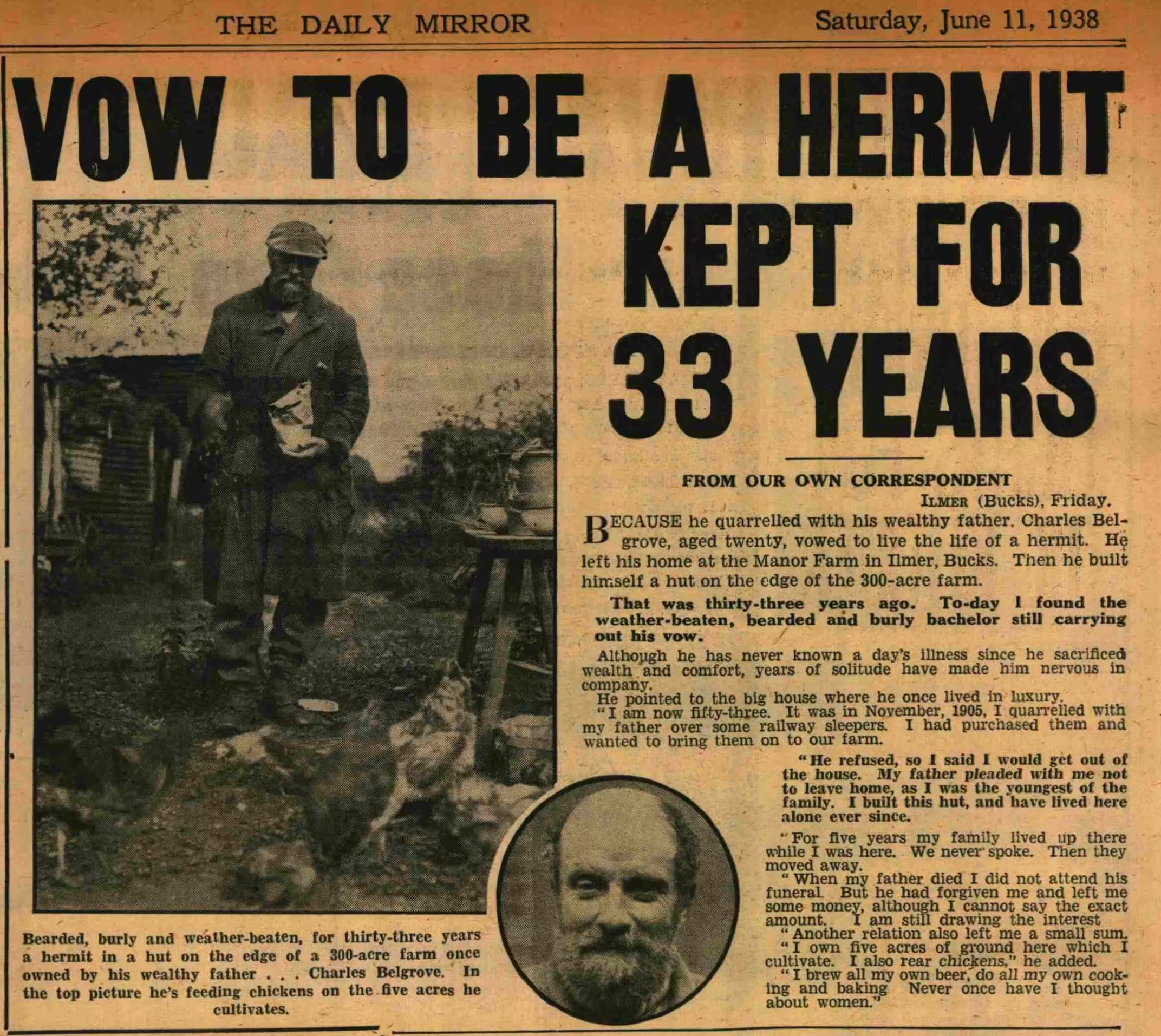
During the 20th century, Charlie Belgrove lived here. The Bucks Herald described him being inside a hut when they went to interview him. Could this be it?

Nearby is another well, this time about 5 foot in diameter with an early 20th century kitchen stove falling in.

This well is probably the one Charlie built. Basil Purssell, Bucks Herald artist and local musician, wrote about it being 50 foot deep in the following magazine article:

Aerofilms
1948 Aerofilms photograph showing Lockington when Charles was resident.
Memories of Charles Belgrove
Bob Uglow, farmer of A J Walker's Sandpit farm in Bledlow/Holly Green remembered Charles in the Bledlow cum Saunderton parish magazine - The Messenger.
Last month Philip Smith wrote a sentimental piece in The Messenger, recalling the life of Charlie Belgrove entitled ‘The Ilmer Hermit’. It brought back memories of my early days in Bledlow.
Charlie - who always said ‘don't call me Charlie my name is Charles’ was an eccentric rather than a hermit, and as he could only reach his plot of land from Bledlow village by crossing our fields, we often met!
He was a near contemporary in age of my late father-in-law, Arthur Walker, and my understanding is that they both lived in Longwick as young lads. They were both farmer's sons and I think Longwick was a lively place at the turn of the last century!
Arthur told me that Charlie fell out with his father when he was 21 because he was not allowed any say in the running of the family farm. So he acquired a piece of land of his own that has ever since been called Charlie Belgrove’s. It is actually in Saunderton Parish next to Lockington Close. I have records of Lockington Close going back to 1673 and it is described as ‘all that close of meadow or pasture land ...... being in a certain place called Lockington in the parish of Saunderton in the County of Buckinghamshire.’ It is said that Lockington was a hamlet between Ilmer and Bledlow that was wiped out by the Black Death. However, Charlie set himself up farming with chickens and other small livestock, lived in a shepherd’s hut, dug several wells, as Philip mentioned, and also erected a primitive windmill of his own design. According to my father-in-law, Charlie’s antics and unique approach to farming amused the young lads living in Longwick. On one of their regular visits they persuaded him to demonstrate the working of his windmill. Rather than rotate in a vertical fashion his mill rotated horizontally! Once he was inside the structure the lads set it in motion; it picked up speed rapidly and it was only by jamming one of his railway sleepers into the works that they saved Charlie from serious injury. The Longwick lads were also highly amused by his well-digging enterprises. To such an extent that they visited secretly in the night, emptying a bag of coal into one of the wells and going the next day to ask if he was a successful coal miner!
I only knew Charlie during the last few years of his life. I usually met him in Sandpit Lane (then Station Road) as he was on his way to Bledlow Post Office, which was in Church End behind the current letter box. The Post Mistress was Mrs Hilda Heybourn and she had managed somehow to get Charlie a modest pension. He always wore the same clothes, summer and winter, grey tweed coat and trousers, and Wellington boots. If it was raining he tied a close woven sack around his shoulders. He carried a stout stick and another sack slung over his shoulder with binder twine, in which he carried his weekly supplies from Mrs Heybourn.
His walking stick was quite long and on the end was a thistle spud. He was obsessed with weeds. He once accused me of harbouring pernicious weeds and followed up by sending me a letter (with no stamp) addressed to The Farmer, Holly Green, saying that he would inform the authorities of my failure to control the thistles on our farm. He used his walking stick to chop out thistles as he walked home across the fields.
He also once accused me of wrongfully claiming ownership of some land because it was Lammas Land. This threw me a bit because I didn't know what Lammas Land was. However, he may have been partly right because I later found that Lammas Land featured in a nineteenth century sale catalogue of our farm. Although not now a form of land-ownership, I believe Lammas Land was a kind of split ownership. An individual was entitled to take a hay crop from the land before Lammas Day (1 August) but afterwards it reverted to common grazing for the ‘lattermuth’, or aftermath as it is more commonly known.
Until quite recently the hedges round our fields in the North Mill area of our farm were full of hybrid apple trees, half wild crab and half cultivated varieties. This was the result of Charlie’s pruning and grafting, for he thought it was a good idea to provide fruit for anyone who needed it.
I don’t remember that he was very ill before he died and I’m sure he didn't lie undiscovered for six weeks after he died because Mrs Heybourn would have alerted someone to his absence from visiting the Post Office. Mrs Alice Haines, who did housework at Holly Green Farm and whose husband Alf worked on the farm for over 50 years, told me ‘ Do you know, ‘though he lived in that hut with no running water, when they found him his body was as clean and as fresh as pink !!’
Today ‘Charlie’s’ piece of land is completely overgrown, most of the structures and wells have disappeared but there is one apple tree next to the footpath that runs along the edge of the enclosure that still bears beautiful eating apples.
November 20??
Census Transcripts
Census records, transcribed by Deborah Dobbs.
Note: The original 1861 census records Mary Allen being 99 years old, but based on prior census transcripts this is incorrect and Mary would have been 90 years old.
| Year | Dwelling number | Forename | Surname | Relation to head | Condition | Age | Occupation | Where born |
|---|---|---|---|---|---|---|---|---|
| 1841 | 52 | Mary | Allen | 70 | lacemaker | Bucks | ||
| 1841 | 52 | Rebecca | Allen | 30 | Bucks | |||
| 1841 | 52 | Joseph | Allen | 25 | ag lab | Bucks | ||
| 1841 | 52 | James | Allen | 2 | Bucks | |||
| 1841 | 53 | Thomas | Allen | 35 | ag lab | Bucks | ||
| 1841 | 53 | Mary | Allen | 30 | lacemaker | Bucks | ||
| 1841 | 53 | Elizabeth | Allen | 10 | Bucks | |||
| 1841 | 53 | Maria | Allen | 8 | Bucks | |||
| 1841 | 53 | Ann | Allen | 6 | Bucks | |||
| 1841 | 53 | Mary | Allen | 3 | Bucks | |||
| 1841 | 53 | William | Allen | 6/12 | Bucks | |||
| 1841 | 54 | William | Roberts | 50 | ag lab | Bucks | ||
| 1841 | 54 | Mary | Roberts | 55 | Bucks | |||
| 1841 | 54 | Dominick | Gregory | 84 | ag lab | Bucks | ||
| 1841 | 55 | Joseph | Burnham | 30 | ag lab | Bucks | ||
| 1841 | 55 | Lydia | Burnham | 20 | lacemaker | Bucks | ||
| 1841 | 55 | Emma | Burnham | 2 | Bucks | |||
| 1841 | 56 | Thomas | Watson | 40 | ag lab | Bucks | ||
| 1841 | 56 | Mary | Watson | 30 | lacemaker | Bucks | ||
| 1841 | 56 | Fanny | Watson | 8 | Bucks | |||
| 1841 | 56 | Harriet | Watson | 6 | Bucks | |||
| 1841 | 56 | Thomas | Watson | 1 | steward | No | ||
| 1851 | 1 | Thomas | Allen | head | wid | 42 | ag lab | Saunderton |
| 1851 | 1 | Ann | Allen | dau | unm | 15 | lacemaker | Saunderton |
| 1851 | 1 | Mary | Allen | dau | unm | 13 | lacemaker | Saunderton |
| 1851 | 1 | William | Allen | son | unm | 10 | Saunderton | |
| 1851 | 1 | Lucy | Allen | dau | unm | 8 | lacemaker | Saunderton |
| 1851 | 1 | Jane | Allen | dau | unm | 6 | Saunderton | |
| 1851 | 2 | Joseph | Burnham | head | mar | 40 | ag lab | Bucks Kings |
| 1851 | 2 | Lydia | Burnham | wife | mar | 30 | lacemaker | Saunderton |
| 1851 | 2 | James | Burnham | son | unm | 5 | scholar | Saunderton |
| 1851 | 2 | Charlotte | Burnham | dau | unm | 2 | Saunderton | |
| 1851 | 3 | Joseph | Bass | head | mar | 32 | ag lab | Princes Risborough |
| 1851 | 3 | Drusilla | Bass | wife | mar | 32 | lacemaker | Princes Risborough |
| 1851 | 3 | Maria | Bass | dau | unm | 13 | lacemaker | Princes Risborough |
| 1851 | 3 | Emma | Bass | dau | unm | 10 | lacemaker | Princes Risborough |
| 1851 | 3 | Bella | Bass | dau | unm | 4 | Princes Risborough | |
| 1851 | 4 | Joseph | Allen | head | mar | 34 | ag lab | Saunderton |
| 1851 | 4 | Mary Ann | Allen | wife | mar | 29 | lacemaker | Haddenham |
| 1851 | 4 | Susanna | Allen | dau | unm | 7 | lacemaker | Bledlow |
| 1851 | 4 | Emma | Allen | dau | unm | 4 | Lockington | |
| 1851 | 4 | Caroline | Allen | dau | 2 | Lockington | ||
| 1851 | 4 | Joshua | Allen | son | 2/12 | Lockington | ||
| 1851 | 5 | Mary | Allen | head | wid | 80 | lacemaker | High Wycombe |
| 1851 | 5 | Emma | Burnham | gr dau | 12 | lacemaker | Lockington | |
| 1851 | ||||||||
| 1851 | 6 | Charles | Bishop | foreman | unm | 21 | papermaker for G | Herts St Ste |
| 1851 | 6 | Mary Ann | Austin | housekee | unm | 32 | Herts Rickm | |
| 1851 | 6 | Louisa | Austin | visitor | unm | 19 | dressmaker | Herts Rickm |
| 1861 | 45 | Thomas | Allen | head | mar | 52 | ag lab | Lockington |
| 1861 | 46 | Richard | Kingham | head | mar | 53 | ag lab | Haddenham |
| 1861 | 46 | Amelia | Kingham | wife | mar | 52 | lacemaker | Wescott |
| 1861 | 46 | James | Kingham | son | mar | 20 | ag lab | Ilmer |
| 1861 | 46 | Benjamin | Kingham | son | unm | 14 | ag lab | Ilmer |
| 1861 | 46 | Elizabeth | Kingham | dau | unm | 11 | lacemaker | Ilmer |
| 1861 | 46 | Jane | Kingham | dau | 8 | lacemaker | Ilmer | |
| 1861 | 46 | Eliza | Kingham | dau | 5 | Ilmer | ||
| 1861 | 47 | James | Kingham | head | mar | 45 | ag lab | Ilmer |
| 1861 | 47 | Rebecca | Kingham | wife | mar | 45 | lacemaker | Somerleys |
| 1861 | 47 | Jesse | Kingham | son | unm | 25 | ag lab | Somerleys |
| 1861 | 47 | James | Kingham | son | unm | 21 | ag lab | Somerleys |
| 1861 | 47 | Mary Ann | Kingham | dau | unm | 18 | lacemaker | Longwick |
| 1861 | 47 | Joseph | Kingham | son | 14 | ag lab | Longwick | |
| 1861 | 47 | Sarah | Kingham | dau | 12 | lacemaker | Longwick | |
| 1861 | 47 | Ann | Kingham | dau | 10 | Longwick | ||
| 1861 | 47 | Lucy | Kingham | dau | 5 | Lockington | ||
| 1861 | 47 | William | Kingham | son | 1 | Lockington | ||
| 1861 | 48 | Joseph | Burnham | head | mar | 50 | ag lab | Ilmer |
| 1861 | 48 | Lydia | Burnham | wife | mar | 45 | lacemaker | Lockington |
| 1861 | 48 | James | Burnham | son | unm | 14 | ag lab | Lockington |
| 1861 | 48 | William | Burnham | son | unm | 19 | ag lab | Lockington |
| 1861 | 48 | Amelia | Burnham | dau | 6 | scholar | Lockington | |
| 1861 | 48 | Frederick | Burnham | son | 3 | scholar | Lockington | |
| 1861 | 48 | Mary | Allen | lodger | wid | 99 | lacemaker | High Wycombe |
| 1861 | 61 | William | Kane | head | mar | 32 | ag lab | Bledlow Ridge |
| 1861 | 61 | Mary | Kane | wife | mar | 26 | lacemaker | Bledlow Ridge |
| 1861 | 61 | Catherine | Kane | dau | 6 | Bledlow Ridge | ||
| 1861 | 61 | Maria | Kane | dau | 4 | Bledlow Ridge | ||
| 1861 | 61 | Elizabeth | Kane | dau | 3 | Bledlow Ridge | ||
| 1861 | 61 | Ann | Kane | dau | 1 | Bledlow Ridge | ||
| 1861 | 62 | Thomas | Beach | lodg | unm | ? | carter | did not know |
| 1861 | 62 | Thomas | Gunnell? | lodg | unm | ? | carter | did not know |